Chasing a Ghost: Chapter Ten - No Set Path
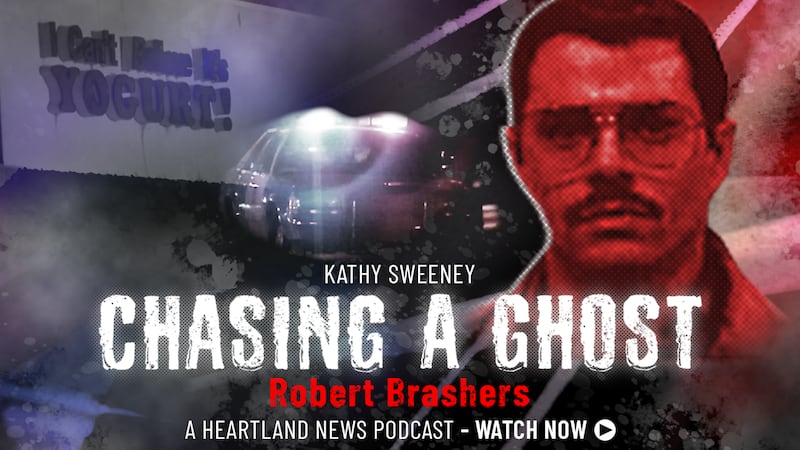
CAPE GIRARDEAU, Mo. (KFVS) - Robert Brashers didn’t just cross state lines. Investigators say he lived without a “set path,” moving often enough to make him hard to track and even harder to anticipate.
In Episode 10 of Chasing a Ghost, Kathy Sweeney follows the map of Brashers’ movements, the gaps detectives are still trying to fill, and what newly surfaced Navy records reveal about the early warning signs that preceded the violence.
The following is a transcript of the tenth installment of “Chasing a Ghost” -- an 11-part series from Heartland News Anchor and Investigative Reporter Kathy Sweeney.
Kathy Sweeney (host): Why do you think people don’t know enough about this guy?
Terry Stevens: For one thing, he moved around so much. He didn’t have a certain particular, so to speak, hunting area.
Chief Freddie Hill: We don’t know if he was just—happened to be traveling through and done this—or what connection he really had here.
Det. Dan Jackson: There’s really no Kentucky connection in our case file. There’s no Texas. So, it was like, well, again, this is some drifter who has no connection to either state. We were correct.
Kathy Sweeney (host): When Robert Brashers was traveling through your town, it wasn’t clear if he was there to steal a car, rob a restaurant, or look for another victim.
Brashers truly was, as we just heard stated, a serial killer without a hunting area. So, trying to figure out where other possible victims might be is no easy task.
One possible clue could come from the “regular life” Brashers pretended to live outside of his crimes. Do a quick Google search and you’ll see he worked in construction.
But dig a little deeper and you’ll find a man who seemingly started off with a bright future only to sabotage it. A man who jumped from job to job, leaving little to no impression behind.
And a man so unsure of himself, he thought about ending it all months before that standoff in a Missouri motel room.
Because just like the investigators tracking his crimes, Robert Brashers had no idea where he was going.
Dan Jackson: What if it was just a drifter? And that’s why nobody knows him.
Nonnie Laux: …and then you walk in and see what someone has done to them?
Chris Hensley: I’m don’t know how we kept missing him—he just slipped through every crack there was.
Terry Stevens: I’m just a firm believer that there’s more cases out there.
Deborah Brashers: My mother would leave for work and tell us—do not let him out of the house.
Chris Hamlett: He doesn’t always stick to the same weapons. He doesn’t always do things the same way.
Angie Ayers: At the end of the day, it’s for the girls. So, you need to make damn sure you’ve got all the answers.
Kathy Sweeney (host): I’m Kathy Sweeney. This is Chasing a Ghost. Chapter Ten: No Set Path.
This episode contains references to murder, sexual assault, and suicide that may be considered disturbing for some listeners. Please, listen with care.
Kathy Sweeney (host): Long before Robert Brashers became the Yogurt Shop suspect in Austin, Texas, investigators in southeast Missouri knew they were dealing with a killer who would be hard to track.
Highway Patrol master sergeant Chris Hamlett is part of the multi-state team trying to do that right now.
Sgt. Chris Hamlett: He’s transient. He is a transient career criminal. And basically, whatever crossed his mind, he was going to do it.
Kathy Sweeney (host): Hamlett and his partner, Sergeant Alex Lacey, both worked on the Sherri and Megan Scherer case. And they know it did not take long for lead investigator Bud Cooper and his team to determine the mother, and her 12-year-old daughter were likely shot to death in 1998 in their own home by a stranger.
Sgt. Chris Hamlett: I think, from talking to Sergeant Cooper, I think that was always a thought—especially after the initial couple weeks into the investigation and the tie to Dyersburg—is that you couldn’t link those two together to make it make any sense. So, the writing was kind of on the wall that this has to be random.
Sgt. Alex Lacey: Especially with the location right there, literally on the interstate.
Sgt. Chris Hamlett: Yeah.
Kathy Sweeney (host): And that same stranger had tried to force his way into a home with children in Dyersburg, Tennessee just hours later.
Here’s Sergeant Bud Cooper talking about the connection between the crimes in 2017.
Sgt. Bud Cooper: Certainly, you would think that there were similarities. He’s using some type of ruse to talk to Sherri and Megan. Or they’re separated and he pulls the gun on one or the other.
Kathy Sweeney (host): Leads in the Scherer case also reinforced the transient nature of the killer they were searching for.
First, a DNA match in 2006 took them back to 1990 and over to South Carolina—where they also learned their killer did not just shoot his victims. Or target children to sexually assault.
He had also assaulted, beat, and strangled a 28-year-old woman.
This is retired Highway Patrol captain Phil Gregory.
Phil Gregory: When we had those two—both of those households in Portageville and Dyer County had children in them. And there was evidence outside with toys and so on that there were kids in the house.
So, the theory at that point was that they were targeted because of something the suspect saw driving down the road.
And then enter in ’06—Genny Zitricki. And that’s an eye-opening thing that, wait, it’s not all about kids after all.
Kathy Sweeney (host): And then in 2017, another community and another curve ball.
Their killer had sexually assaulted another young girl—a 14-year-old—in front of her frightened family in Memphis, Tennessee one year before the Scherer murders.
On October 5, 2018, with genetic genealogy and a court-ordered exhumation, authorities announced they had unearthed their long-dead transient serial killer—Robert Eugene Brashers.
Linking Brashers to three crimes in three states that had no other connection had taken 20 years.
Now, these same southeast Missouri investigators—many of them retired—understand what authorities in Austin, Texas and other states are up against when it comes to tracking Brashers.
Here’s current Portageville police chief Freddie Hill and former New Madrid County sheriff Terry Stevens.
Chief Freddie Hill: Yeah, he didn’t stay in one place very long. He kept on the move.
I would say the authorities in Austin didn’t know anything about our case until we got the match.
Terry Stevens: They never, during their investigation, thought, I wonder if this is a guy that done those ones up in Missouri and out in South Carolina.
Kathy Sweeney (host): No, but Detective Jackson brought that up to me and said he wished he would have heard of him.
Terry Stevens: Yeah.
Kathy Sweeney (host): Detective Jackson is Dan Jackson—the Austin cold case detective credited with finding the evidence linking Robert Brashers to the 1991 Yogurt Shop murders.
Det. Dan Jackson: Surprisingly, he wasn’t anywhere in our case file as a tip to look at. And we’ve got every serial killer in America we’ve looked at. Except for him.
Kathy Sweeney (host): Jackson told me if he’s being honest, he doesn’t remember even hearing Brashers’ name before DNA linked Austin’s quadruple murder case to the 1990 murder of Genny Zitricki.
Det. Dan Jackson: It’s not like a unique name that you’re going to never forget.
So, I may have totally saw a news story on it and just didn’t remember the name Robert Brashers.
I wasn’t in homicide at the time, so…yeah, I mean, it’s very possible.
Kathy Sweeney (host): Is now the time that people should know this man’s name?
Det. Dan Jackson: Yeah, I think so.
Especially with how much we can do with less when it comes to DNA.
You’ve got these cases that were unsolvable a few years ago because the amounts were too low.
What they can do with genealogy now is in the picograms, and they can do it with mixtures. It wasn’t even possible a year ago.
So, there’s a lot of stuff that needs to be revisited.
Because he’s probably—like I said—he’s good for more.
Kathy Sweeney (host): The “more” crimes Robert Brashers may be good for could have been committed a long time ago—anywhere from the mid-70s to late 90s when you take out his two stints in prison.
The key windows of time investigators are focused on can be sectioned off by decade: the mid to late 70s, early to mid-80s, and then very early 90s—plus the last two years of his life from 1997 to 1999.
Det. Dan Jackson: So, it was a lot easier to cover your tracks, especially when you’re crossing state lines to offend and nobody knows you.
We don’t have 24-hour CNN and Facebook and everything isn’t plastering your face 24/7.
So yeah, I’m sure that’s how he got away with it for so long—as he was changing things up that way.
Kathy Sweeney (host): We know he was in the Navy in ’76.
Det. Dan Jackson: For about 10 months. Yeah.
But from the obituary in New Orleans to his arrest in Florida, we really don’t have a lot on him.
Kathy Sweeney (host): But thanks to his daughter Deborah, I can tell you about a much younger Robert Brashers—not only about where he was, but the direction his life seemed to be heading.
Deborah recently received copies of her father’s Naval records, and she shared them with me.
And you may be shocked to hear they actually reveal a bright young man on what appears to be the start of a solid military career.
But that career quickly fell apart.
Kathy Sweeney (host): Robert Eugene Brashers enlisted in the Navy in El Paso, Texas on March 31, 1976.
Brashers had just turned 18 and should have still been in high school.
But his naval records indicate he graduated early—and had a graduation letter attached to his application.
They also show he would have been considered an “above average” recruit based on his mental and aptitude test scores.
According to online information provided by the Office of Veterans Affairs, Category two recruits like Brashers were often considered for specialized roles in the Aviation, Intelligence, or advanced mechanical fields.
Brashers’ enlistment application also gives us a glimpse into his teenage years.
He spent his sophomore and junior years at Butler High School in Huntsville, Alabama, where he participated in Junior ROTC.
Deborah gave me two photos of her father from that time.
Both are group photos. In the first, Brashers stands in a ceremonial uniform complete with a parade cap, white ascot, and gloves.
He is holding a rifle and staring into the camera.
In the second photo, he is in a Class A uniform with a black tie, garrison hat, and gold shoulder cord.
He is also looking straight ahead at the camera.
Robert Brashers’ naval application shows he worked three jobs as a teenager in Huntsville—at Manpower, at a local pizza place, and at a business that sold CB radios.
In 1975, Brashers moved to South Bend, Indiana where he spent his shortened senior year at John Adams High School.
His application also reveals some minor brushes with the law—a parking ticket in South Bend and a speeding ticket in Niles, Michigan—both in 1975.
And he admitted to experimenting with marijuana—but signed a statement rejecting the use of it and other drugs.
After he begins serving in the Navy, Brashers’ records show he is advanced in July 1976 from an airman recruit to an airman apprentice.
Brashers also completed some kind of aviation course just a few days earlier.
But in August, his records hint at the first signs of trouble.
And I found some added context on this in the Scherer case file.
There’s a brief report in the file indicating one of the southeast Missouri investigators reviewed Brashers’ naval records, and it looks like they had access to a few records Deborah did not receive.
So, piecing together what I have and what’s described in the Scherer report, I can tell you the Navy sent Robert Brashers to a naval training station in Memphis, Tennessee from July to August 1976 for training. That’s where he completed the aviation course.
But on August 2, Brashers was enrolled in what’s described as a basic electronics course.
And just eight days later, he dropped out for what’s listed in his records as “lack of motivation.”
The Navy transferred Robert Brashers to the USS Lexington in Pensacola, Florida in September 1976.
But the Scherer investigator also described Brashers as communicating his desire to leave the Navy around this same time—reporting symptoms that included depression and acid indigestion.
Now, let’s pause here for just a moment.
You may have already picked up on something I realized when I first reviewed these records.
Brashers’ very short naval career started in Texas, sent him to Memphis, and then to Florida—all locations of his later crimes.
And he’s on the USS Lexington—named after the same Revolutionary War battle as the city of Lexington, site of what’s believed to be Brashers’ final murder.
Maybe it’s a coincidence, but it sure doesn’t feel like one.
Back to the records.
On November 10, a medical officer sent a psychiatrist’s consultation on Robert Brashers to several naval officials along with a note recommending administrative separation for what was known at the time as “inadequate personality disorder.”
According to the VA, a discharge like that back in the mid-70s was commonly used to remove sailors who demonstrated an inability to adapt to military life.
The short memo recommending Brashers be discharged ends with the sentence: “It is felt that his problems will not resolve themselves with time.”
Robert Brashers was made aware of his honorable discharge from the Navy on December 8.
Brashers checked and initialed the box on a “statement of awareness” form, waiving the right to make a statement on his own behalf.
So, we don’t have anything from him in any of these reports explaining why he wanted out of the Navy so soon after he had joined.
Brashers’ honorable discharge officially took place on December 10, 1976.
He signed his name to several administrative remarks in his final paperwork, including one that reads: “NOT ELIGIBLE FOR REENLISTMENT due to Unsuitability—Personality disorders.”
Kathy Sweeney (host): We don’t know a whole lot about what Robert Brashers did once he left the Navy.
When I reported on Brashers in the fall of 2025, Deborah told me that, according to family, her father worked as a bartender in Huntsville, Alabama and on an oil rig in Louisiana around that time.
This is a period of time where investigators question if Brashers committed any violent crimes.
Remember—in November 1980—he put his own obituary in the newspaper in his hometown of Newport News, Virginia and where he was living in New Orleans.
He did that for a reason.
Austin, Texas detective Dan Jackson managed to pick up Brashers’ trail around 1981.
Det. Dan Jackson: He had a Texas driver’s license for a while. He got one in, I think, ’81—and we don’t know why. The building doesn’t exist anymore. It was a trailer park that’s now just woods.
Kathy Sweeney (host): Have you looked back yet into old, old, old Texas files yet to see if you’ve got anything else?
Det. Dan Jackson: A little bit.
We’ve reached out to the Texas Rangers because they handle a lot of cold cases—especially for smaller jurisdictions—and asked, hey, put this guy on your radar for this kind of MO.
We haven’t found anything from that ’81 time frame, but we have plenty of time to do it—to look for it.
Kathy Sweeney (host): Every Robert Brashers timeline I’ve seen has another hole in it from 1981 to 1984.
We know Brashers turned up in Florida in 1984.
He committed his first documented violent crime in 1985, which sent him to prison from 1986 to May 1989.
After his release, Deborah Brashers told me family told her Robert worked at a heating and air conditioning business in Atlanta, and as a construction worker back in Huntsville.
But in the spring of 1990, you learned in Chapter 9 of this podcast that Brashers landed a maintenance job at a Greenville, South Carolina apartment complex.
Former New Madrid County, Missouri sheriff’s deputy Chris Hensley traveled to Greenville looking for anyone who remembered having contact with Brashers at that time.
Chris Hensley: And nobody remembers him, nobody worked with him.
Nobody that was a resident at the time that he was there brought up that he was weird to them.
Kathy Sweeney (host): And no one knew why he would have targeted 28-year-old Genevieve Zitricki.
Genny was Brashers’ first documented murder victim. But we don’t know if she truly was his first.
And Hensley mentioned something else about Greenville that reminded me: Robert Brashers was not just a serial killer.
He was also a career criminal.
Chris Hensley: There was—just back behind the apartment complex—there was a house with a couple of elderly people, I believe, that somebody had broke in on.
They were home when somebody had broke in late at night.
And we were thinking that might have been Robert breaking in on them.
But there was a couple of unsolved break-ins in the area that we would read through that no suspects were ever arrested.
Kathy Sweeney (host): Certainly could have been him.
Chris Hensley: Yes.
Kathy Sweeney (host): So, there could be other break-ins, or sexual assaults like in the Memphis case, or unsuccessful crimes like in the Paragould neighbor case that could be tied to this killer.
And as they work, investigators are also clearing up some false leads.
For example: Robert Brashers did have a cousin who lived in Austin, Texas in 1991—the same year as the Yogurt Shop murders.
But according to detective Dan Jackson, that cousin had no connection to Brashers, and had no idea they were even related until Jackson told them they were.
Kathy Sweeney (host): It’s no cliché to say Robert Brashers was all over the map—as a serial killer and as a person in general.
In the fall of 2025, I stood in front of a map of the United States with Missouri State Highway Patrol investigators Chris Hamlett and Alex Lacey as they put red tabs down on all the states Brashers had a connection to.
His home state of Virginia. Alabama. Indiana. Louisiana.
His murder states: South Carolina, Missouri, Kentucky, and Texas.
Sergeant Hamlett noted a change in Brashers’ movement when they learned he was the prime and only suspect in the Yogurt Shop murders.
Sgt. Chris Hamlett: But then when we connect Austin to it, it’s like, okay, so he’s traveling more extensively maybe than what we thought.
And then we know that at one time he had a connection in Washington as well. So, he’s traveling extensively.
So, you look at the map and I think anything’s a possibility at this point.
Sgt. Alex Lacey: You can’t rule anything out.
Kathy Sweeney (host): They’re coast to coast now.
Sgt. Chris Hamlett: Yes. I think this is obviously home base.
Kathy Sweeney (host): Sergeant Hamlett pointed to the southwestern portion of the United States as he spoke.
Sgt. Chris Hamlett: This is where he’s comfortable. But what’s taking him out here? We don’t know.
Kathy Sweeney (host): I found Texas investigators wondering the same thing.
Mindy Montford worked on the Yogurt Shop case for years, most recently with the Texas Attorney General’s Office.
Kathy Sweeney (host): How big might this get, you think?
Mindy Montford: That’s what’s crazy because you look at the map and I had a whole map in our office with pins.
You know where he’d been and you know most of it was sort of confined to that—from Florida on up right to the eastern border.
And then you had Kentucky, you’ve got Tennessee a little bit out there, and then we know he was in Texas, he’s got the Arkansas…
I remember buying that map actually. They had options like you could do the southeastern part of the United States or you could do the full part of the United States.
And I thought, with this guy, I’m going to do the full United States. I can’t limit it.
Kathy Sweeney (host): Montford also saw something seen by other investigators who put Brashers and his crimes on a map.
Mindy Montford: You can see how easy it was for him to move from state to state.
When you see it on paper, you think, wow—he was in this state one day and then the next state.
But really, those cities were right along the border. He was able to just hop a couple of hours away.
Kathy Sweeney (host): So, maybe Brashers’ crimes are all within a couple of hours of where he lived.
But if investigators don’t know where he lived for years at a time—you can see the challenges they face.
And they still are coming up empty when it comes to friends, acquaintances, or possible accomplices.
It’s clear his father helped him on some level—bailed him out of jail, recovered a likely murder weapon from federal custody.
But Doulis Brashers, like his son, is long gone.
Missouri sergeants Chris Hamlett and Alex Lacey have talked to Brashers’ living brother, Gary.
You may remember Brashers told the victim in his 1985 attempted murder case his name was Gary.
Sgt. Alex Lacey: I can speak to the living brother. Nothing but kind to us, nothing but cooperative to us.
He was devastated when we told him.
To say that him and Robert lived different lifestyles, I think, is an understatement.
I don’t want to speak for him, but I’m assuming him and Robert didn’t have much of a relationship.
They had really kind of distanced themselves because he knew—he was a contributing member of society from what I could tell.
And he knew that Robert was a very, very poor decision maker—and that’s as nice as I can possibly put that.
So, I think he’s the kind of guy that if he knew, he would say something.
Sgt. Chris Hamlett: Yeah. He struck me as the kind of person that if he would have known, he wouldn’t have been able to lie about it.
Sgt. Alex Lacey: No.
Sgt. Chris Hamlett: And he was extremely forthcoming with us.
Even after we had spoke with him, I was in contact with him for some time.
And anything that popped in his mind—just, oh, I think he might have been in this town one time or so—just racking his brain trying to help us.
Kathy Sweeney (host): It’s something Robert Brashers’ daughter Deborah continues to do—try to help law enforcement track his movements and crimes.
Deborah can vividly remember the time she spent with her father in 1998—a violent year that would prove to be the last year of his life.
Brashers was back in Paragould, Arkansas, working construction.
He was living with his longtime partner, Rose, and her three daughters.
But he could not control his rage.
In March, Brashers drove to Portageville, Missouri where he murdered Sherri and Megan Scherer.
He kept driving, and attacked a Dyersburg, Tennessee family that same night.
Brashers came back home and tried to break into his neighbor’s house with a gun and a video camera two weeks later.
And while he was out on bail in that case, he ran a vehicle into a fence after robbing a different Paragould neighbor.
It’s behavior that caused Deborah to tell me this during our first interview in 2019.
Deborah Brashers: And the family man and the serial killer and rapist did not mix until ’98 when he started going crazy.
My mother would leave for work and tell us—do not let him out of the house.
Kathy Sweeney (host): We talked about it again during our recent visit in late March.
When you look now—knowing everything you know—and you look back at that period of time: the crimes committed, the two arrests in Arkansas, the rug hiding, the game playing, the talk about him going crazy…
Deborah Brashers: I’m never going back to prison. I’m not going back to prison.
Kathy Sweeney (host): Did you see the wheels coming off?
Deborah Brashers: Slowly, yes.
Kathy Sweeney (host): The walls closing in on him. He’s making mistakes.
Deborah Brashers: He’s falling apart.
Kathy Sweeney (host): Deborah believed her father knew he was living on borrowed time.
So much so, that he actually tried to take his own life in the late summer of 1998.
Here’s what she remembers.
Deborah Brashers: He took knives. I had a tape recorder of him saying, I wonder if this is going to hurt.
And it sounded like a saw in the background.
For the longest time I had it—it sounded like a saw in the background.
And he’s like, oh, I wonder if this is gonna hurt.
And the next thing he knows, his neck and his arm’s cut.
So, we thought— I thought that maybe that’s when he hurt himself.
But he cut his own arm and his own neck trying to kill himself in August of ’98—seven days before my birthday, matter of fact.
And we thought, okay.
He’s running around screaming: I’m not going back to prison, I’m never going back to prison…
So, he knew he was about to die. He knew his death was coming close.
Kathy Sweeney (host): But Robert Brashers would live another five months.
He still had time to sneak away to Lexington, Kentucky and kill Linda Rutledge at her parents’ hearing aid center.
And now Deborah Brashers knows her father killed four girls in a Texas yogurt shop when she was just a baby.
It left her thinking what would have happened had he just served that full 12-year prison sentence in Florida.
Kathy Sweeney (host): You said something that really shocked me—and you said, “I wish he would have served that sentence. I wouldn’t have been born, but that’s okay.”
Deborah Brashers: Yes. Because there’s how many different lives.
I have a child. I love my life.
But if the person that helped create you has killed eight people—and if they would have kept him in prison before you were born—then I mean, to trade your life for eight people’s lives, who wouldn’t?
Kathy Sweeney (host): So, had Robert Brashers served his full Florida sentence for attempted murder—or even half of it—Genevieve Zitricki would still be with us.
Sarah and Jennifer Harbison. Eliza Thomas. Amy Ayers.
They would all still be with us.
A serial killer’s path would not have been set.
But what about Deborah’s?
Deborah Brashers: I wish they would have never let him out. I would have been born regardless—just not to him.
Kathy Sweeney (host): Robert Brashers’ life, his death, his crimes—left permanent scars on so many people.
But there is a real fear that his story is not over. That his victim count will grow when investigators link another cold case to the long-dead serial killer.
It took 20 years to solve the murders of Sherri and Megan Scherer.
Twenty-seven years for Linda Rutledge.
Twenty-eight years for Genevieve Zitricki.
And 34 years for the families of Amy Ayers, Eliza Thomas, and Sarah and Jennifer Harbison to learn about a new Yogurt Shop suspect.
And now, Shawn and Angie Ayers don’t want to see other families waiting decades in limbo like they did.
Angie Ayers: There’s probably some other people out there without answers. And we deserve to help them get those.
I don’t want there to be. I hope that it’s ended. I hope it ended at…we just found out about the—or we knew about it—but Kentucky just found out about theirs.
I hope that’s it.
Kathy Sweeney (host): But it probably isn’t.
Angie Ayers: Right.
Kathy Sweeney (host): That’s next in Chapter 11 of Chasing a Ghost: Never Again.
Copyright 2026 KFVS. All rights reserved.